

After months of speculation and just days after leaked screenshots surfaced, Bethesda and Microsoft have officially announced, and stealth-launched The Elder Scrolls IV: Oblivion Remastered, a remake of the beloved 2006 RPG.
Developed by Virtuos, a Singapore-based studio renowned for its work on remakes and ports, Oblivion Remastered utilizes Unreal Engine 5 to deliver a significant visual upgrade. However, the remake has sparked heated discussion not only over its technical and artistic direction but also due to its decision to replace traditional male and female character labels with “Body Type” options, a move that adopts modern day progressive gender ideology.
This change, along with others, has drawn praise from activists for “promoting inclusivity” and sharp criticism from consumers who view it as a deviation from the original game’s identity.
Technically speaking, the transition to Unreal Engine 5 marks a departure from Bethesda’s notoriously outdated Gamebryo engine. While this should have been a welcome leap forward, Oblivion Remastered instead feels caught in an uncanny middle ground a blend of UE5 visuals and legacy Gamebryo scripting designed to harmonize.
Gameplay systems have been significantly overhauled, with Bethesda describing the remake as “the best of both worlds,” blending mechanics from Skyrim and Oblivion—including a modernized UI, revamped leveling, and improved audio.
Virtuos’ influence is immediately noticeable: Cyrodiil, once a vibrant imperial province, now at times resembles a muted, Fallout-esque wasteland. The lush forests that defined the original are largely gone, replaced by gray and beige landscapes that lean heavily into a more grounded, realistic but bland aesthetic.
And that’s just the beginning when it comes to how far the character designs have strayed in this modern remake. Several races now appear overly detailed to the point of being grotesque, and female characters in particular look significantly less appealing compared to their counterparts in the original Oblivion.


Right: The Elder Scrolls IV: Oblivion Remastered
Though Unreal Engine 5 brings a visually impressive upgrade, the remake’s artistic direction strays far from the original’s charm and atmosphere. Feature-wise, it introduces sprinting, an improved third-person camera, updated dialogue, and bundles in all original DLCs, including Shivering Isles and Knights of the Nine.
Despite the criticism, Oblivion Remastered has been a commercial powerhouse. Launching at $50 and $60 for the Deluxe Edition, which includes extras like horse armor DLC, a cancerous homage to the original Oblivion, the game dropped on PC, PlayStation 5, Xbox Series X/S, and Xbox Game Pass and to the surprise of nobody has been quite successful.

It peaked at 182,298 concurrent players on Steam on day one alone. The strong debut highlights the vast appeal of The Elder Scrolls franchise, with the original Oblivion having sold nearly 10 million copies to date and Skyrim still pulling around 30,000 concurrent players nearly two decades after its 2011 debut.

On the bright side, Oblivion Remastered stands as further proof that services like Xbox Game Pass aren’t entirely cannibalizing sales, rather Microsoft have just been producing nothing but shit for the past couple of years.
The Elder Scrolls franchise still wields immense brand power, and fans have been hungry for something new from Bethesda for over a decade. Starfield may have come and gone, drawing in hundreds of thousands at launch only for many to return to Skyrim soon after as the game was rather underwhelming.
So when the remaster hit 182,298 concurrent players on Steam alone on day one, it wasn’t shocking. That’s more than Redfall, Avowed, and South of Midnight combined. Game Pass or not, this was always going to sell.

And that’s what makes it so frustrating to see it leveraged as a vehicle for ideological messaging.
One of the most contentious changes in Oblivion Remastered is the removal of traditional male and female character options, replaced by “Body Type 1” (defaulting to female) and “Body Type 2” (male).

This shift aligns with trends seen in games like Capcom’s Monster Hunter, RuneScape, and other remakes and remasters such as Freedom Wars and most especially Dragon Quest III HD-2D. All of which have sparked criticism as part of a broader push for meaningless gender ideology, often seen as driven by ESG and DEI goals.
Critics argue that removing biological sex descriptors undermines reality and panders to a small, vocal minority, ultimately alienating the majority of the whole world, let alone players.
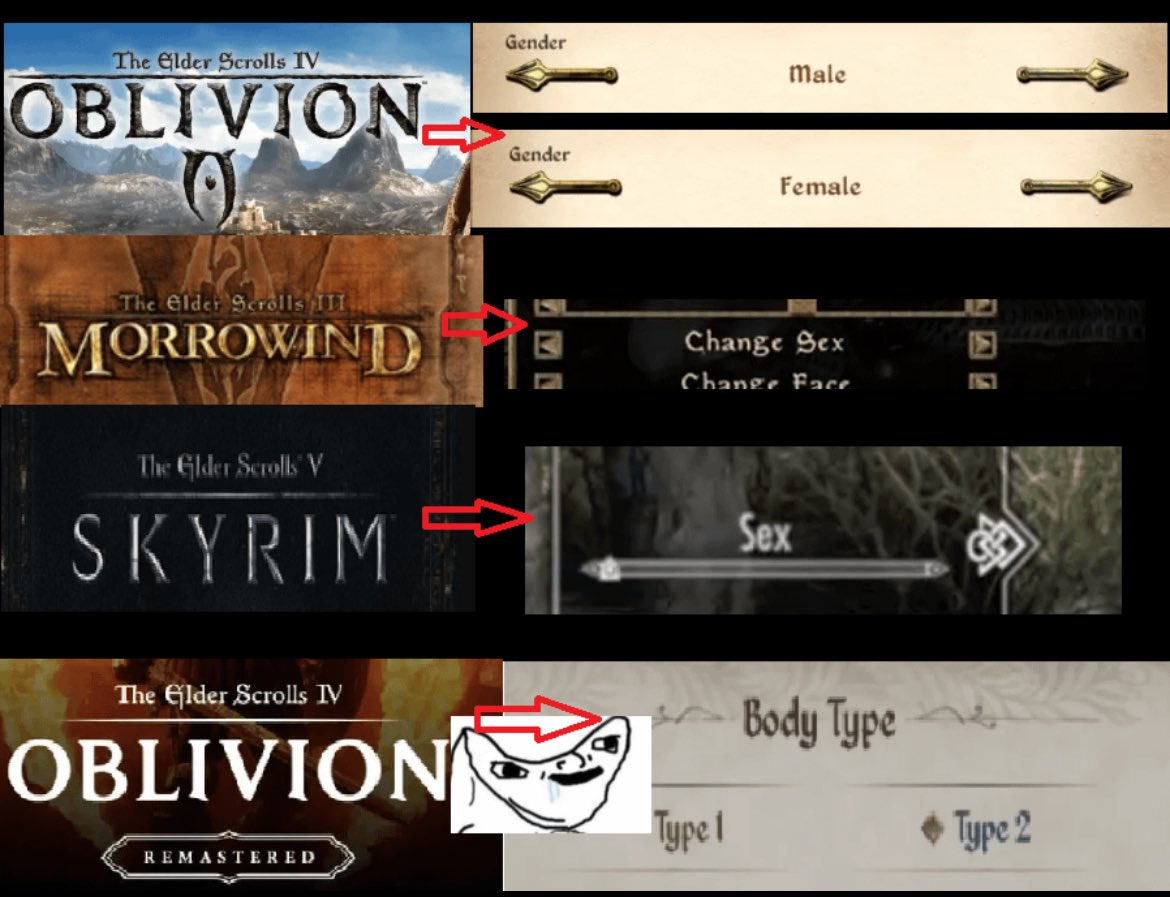
Twitter has been buzzing with backlash, with some users complaining that the change forces players into playing “as a trans character,” while others express concern over how it impacts quests like “The Siren’s Deception,” where gender (now “Body Type”) used to influence dialogue.
The original quest, which involves women seducing and robbing men (or recruiting female players), relies on clear sex distinctions. One might wonder whether the remake’s dialogue has been adjusted to fit the new “Body Type” terminology, potentially diluting the narrative’s clarity and prioritizing political correctness over authenticity.
However, it’s likely that the remake will keep the traditional male and female references in the dialogue, making the removal of these terms from the character creator seem more performative than meaningful. After all, do you expect the player character would be referred to as either “Body Type 1” or “Body Type 2” during in-game conversations? Of course not.
Activist supports of the change argue it’s a minor update meant to reflect modern inclusivity, brushing off critics as overblown in their reactions. They claim that the “Body Type” options add flexibility without affecting gameplay, and point to similar systems in successful games like Palworld and or Elden Ring as evidence of its acceptance.
As expected, the modding community wasted no time, and within hours of the game’s release, mods were available to restore the original game’s vibrant green palette and revert to the classic gender labels.

The quick enforcement of these changes, particularly with NexusMods swiftly banning the mod that restored the traditional male/female descriptors, has sparked accusations of hypocrisy. If the change is truly insignificant, why does reversing it create such a stir?
The “Body Type” mod was banned almost immediately. Why? Because if it “weren’t a big deal,” there wouldn’t be such a strong push to keep it erased, it’s honestly hilarious how Orwellian levels of censorship have to be enforced just to force-feed and uphold such propaganda.

The reality is, they want to erase the status quo, biology, and even reality itself, all to force players to conform to their standards of acceptance. It’s about pushing aside men and women, the entire world specifically to cater a disgustingly small vocal minority of individuals who identify as anything else.

The hypocrisy is maddening. We’re gaslit into believing that such changes “don’t matter,” that they’re just “small tweaks.” Yet the moment someone tries to undo those “small tweaks,” or questions why they needed to be added in the first place they’re criticized or deplatformed.
NexusMods did the same thing with mods removing pronouns from Starfield, plain and simply if your mod doesn’t toe the ideological line, it’s gone.

Fortunately, the mod in question has been re-uploaded to an alternative mod hosting platform, one that supports freedom of expression in all its forms. Unlike others, this platform isn’t bogged down by political agendas, such as promoting blackwashed characters, pride flags, or regressive non-binary pronoun inclusions that have become increasingly prevalent in modern gaming.
Bethesda pushing this agenda isn’t new. Last year, Elder Scrolls Online introduced a gender-confused High Elf named Tanlorin, voiced by drag king Vico Ortiz. The developers proudly showcased this inclusion on social media, as if it were a groundbreaking innovation. Spoiler alert: it wasn’t. It was just identity politics forced into Tamriel, a world once known for its rich lore rather than shallow representation. This trend continues with Starfield and now Oblivion Remaster.
Bethesda, along with Microsoft and Virtuos, have taken a beloved game and decided it needed a neutered identity system and a dull, beige aesthetic to appeal to today’s audience of gaymers.
This isn’t progress; it’s erasure. A remake, by definition, is meant to REPLACE the original, and Oblivion Remastered is quickly becoming the ideological hijacking of your nostalgia.

It’s a Trojan horse, a “success” story that activists will proudly point to as evidence their messaging “works,” even though it’s riding on the coattails of one of the most iconic Western RPG franchises, which would have sold millions regardless of quality.
It’s not just a game; it’s a message: conform, or be left out, even from your own history. As Oblivion Remastered reshapes Cyrodiil for a new generation, it risks alienating the very fans who turned The Elder Scrolls into a cultural phenomenon, sparking debate over whether remakes should preserve the original vision or reinvent it entirely which is almost certainly what Bethesda are planning in regards to the eagerly awaited Elder Scrolls VI.
In stark contrast, Skyblivion, a volunteer-driven mod by the TESRenewal team, seeks to faithfully rebuild Oblivion within Skyrim’s Creation Engine, offering a recreation that outshines Bethesda’s effort both visually and narratively. Skyblivion carefully restores Cyrodiil’s lush forests, rolling hills, and vibrant cities, staying true to the original’s art direction.
Utilizing Skyrim’s advanced lighting and weather systems, it provides a visually stunning update while remaining authentic, avoiding the beige emptiness of Oblivion Remastered which, despite requiring 120GB of storage, feels more like a modern bloated design than an artistic vision.


Gameplay in Skyblivion keeps the core mechanics of Oblivion, spellcrafting, attributes, and class-based progression while integrating Skyrim’s improved combat and UI. Unlike Bethesda’s remake, which overhauls systems to appeal to modern audiences, Skyblivion preserves the RPG depth that made Oblivion a classic, refining rather than reinventing.
The mod includes all quests, voiced dialogue, and DLCs, rebuilt with enhanced textures and models, and is praised for capturing Oblivion’s essence more effectively than Bethesda’s remake. It’s also guaranteed to avoid any “Body Type” terminology.

While Oblivion Remastered is a technical feat, leveraging UE5 to update a classic, its barren Cyrodiil and controversial changes have made it an ideological flashpoint. While commercially successful, it’s been criticized for abandoning Oblivion’s core identity. Skyblivion, on the other hand, stands as a testament to fan passion, delivering a faithful remake that stays true to Oblivion’s spirit, surpassing what Bethesda could have accomplished.
As players dive into the remastered Cyrodiil or wait for Skyblivion to launch, the debate highlights a broader issue in gaming: finding a balance between modern updates and preserving authenticity.

Meanwhile, Bethesda continues to drift into irrelevance with each new ideologically-driven release. What else might have quietly changed in this remake? Its ultra-realistic visuals echo the desaturated look of Avowed, stripping the original of its distinct charm, though this can be somewhat fixed with a reshade preset.

And for nearly full price, players are handed a bloated 120GB version of a game that originally ran at just 4.6GB and could be played on nearly any PC built in the last two decades. To top it off, the infamous horse armor DLC returns, now at twice the price. Ultimately, Oblivion Remastered serves as a case study in modern gaming’s tensions: corporate nostalgia repackaged for profit, ideological tweaks passed off as progress, and a growing disconnect between developers and their most dedicated fans.
As Skyblivion nears completion, it stands not only as a technical achievement, but as a quiet rebellion, proof that authenticity, care, and respect for legacy cannot be bought, but must be earned.
